

Guido Crepax presented by Archivio Crepax
Guido Crepax: The Architect of the Subconscious
Guido Crepax was not merely an illustrator; he was a revolutionary who redefined the boundaries between graphic narrative, cinema, and fine art. A central figure in 20th-century Italian culture, Crepax transformed the "comic" medium into a sophisticated tool for intellectual and aesthetic exploration, blending the rigor of architecture with the fluid world of dreams.

Architectural Precision and the "Analytic Line"
Born and trained in Milan as an architect, Crepax’s work is underpinned by a profound sense of spatial design. This discipline birthed his signature "analytic line"—a razor-sharp, clinical, yet deeply poetic style. Every page he composed was treated as a structural project, where the white space was as vital as the ink, and the layout served to guide the viewer through a complex architectural maze of emotions and details.
The Cinematic Revolution: A New Way of Seeing
Influenced by the avant-garde cinema of the 1960s, Crepax introduced a groundbreaking "montage" technique to the page. Instead of traditional linear storytelling, he broke the narrative into a rhythmic sequence of fragments: a close-up of a gaze, the detail of a lace, a sudden shift in perspective. This approach mirrored the process of human memory and psychological association, making his work a visual translation of the modern consciousness.
From Pop Iconography to Intellectual Symbolism
While Crepax achieved global fame as the creator of Valentina—one of the few characters in graphic fiction to age, dream, and evolve like a real person—his artistic journey reached far beyond the borders of the comic strip. Valentina became an icon of Milanese sophistication and female independence, but she was also the gateway to Crepax’s deeper explorations.
The Freud Portfolio: Mapping the Uncanny
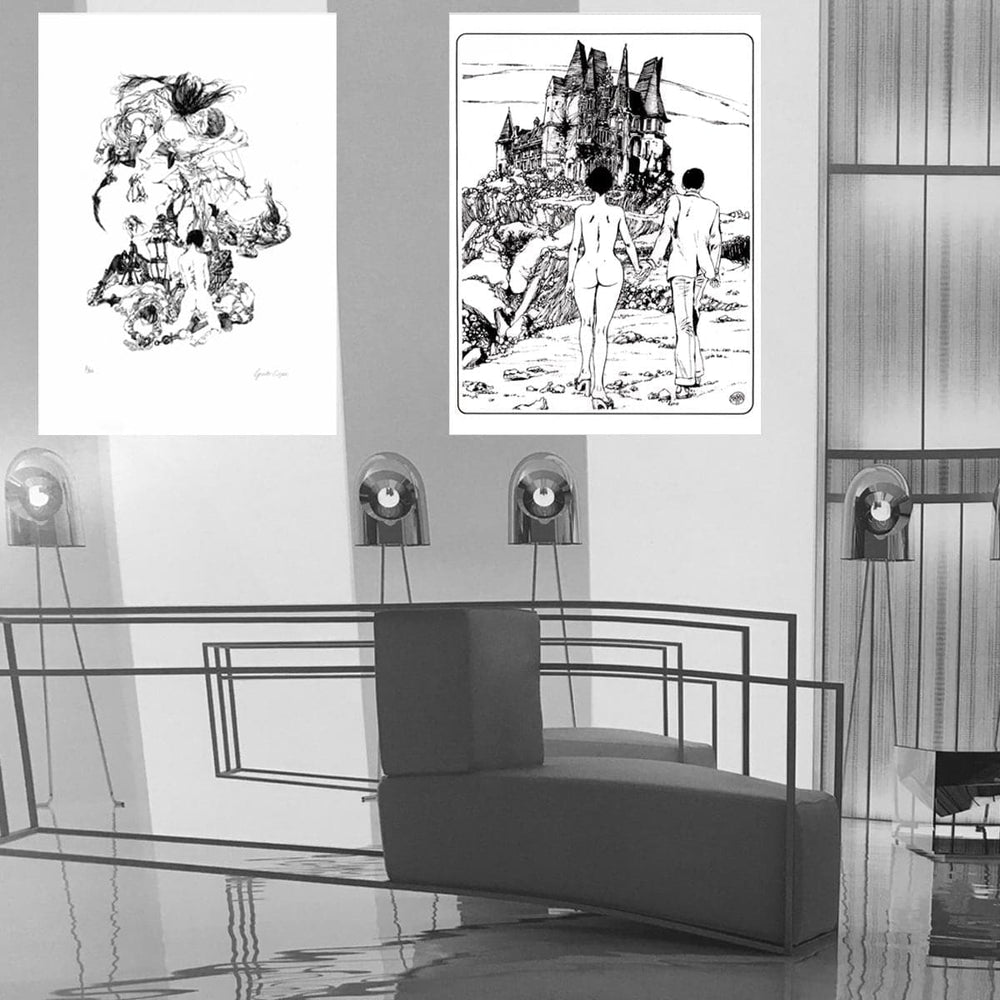
The pinnacle of his intellectual maturity is found in works like the 1978 "Homage to Sigmund Freud." Here, the narrative disappears to make room for pure symbolism. Crepax translates the "Uncanny" (Das Unheimliche) into elegant black-and-white compositions, turning complex psychoanalytic theories into hauntingly beautiful visual metaphors. These lithographs represent the perfect intersection of European intellectualism and graphic excellence.
A Legacy Preserved: The Archivio Crepax Collection
Design Italy is honored to present a selection of works curated in collaboration with Archivio Crepax. The history of these pieces is as evocative as the art itself: for decades, these rare prints and signed lithographs were preserved by the artist's family inside a large nineteenth-century Dutch wardrobe in their Milanese home—a hidden treasure trove of Italian design history.
Owning a piece from this collection is not just an investment in art; it is an invitation to bring a fragment of the "Bello e Ben Fatto" into your private space. These limited editions are essential benchmarks for collectors who seek the sophisticated elegance and provocative genius of a true Italian master.